On Making
◼️ Point of Departure: The Inevitability of Making
Our work at capeesh does not begin with pursuing realism or cuteness as primary aims.
We understand these qualities not as goals, but as something we gradually approach as a result.
So what is it that we are making?
Where is it that we are heading?
There is no clearly defined destination from the outset.
We think while making, and make while thinking.
Looking back on the path we have walked,
we redraw its traces as if mapping them,
searching for both our current position and a possible destination.
This page is not meant to present a finished answer.
It is a record of thought—
a place where we pause along the way to consider where we might be heading,
a small repository of ideas for who we are at this moment.
We revisit, reconsider, and add new realizations from time to time,
so that we do not lose sight of the path.
◼️ Current Position: Designing Presence
Each capeesh piece is shaped while exploring a very small area
where three circles overlap:
Common Image, physical reality, and plushness.
Animals such as cats carry images that overlap in many people’s minds.
Yet these images neither perfectly match the real animal
nor become simplified like a character.
Below are the three perspectives that guide our shaping process.
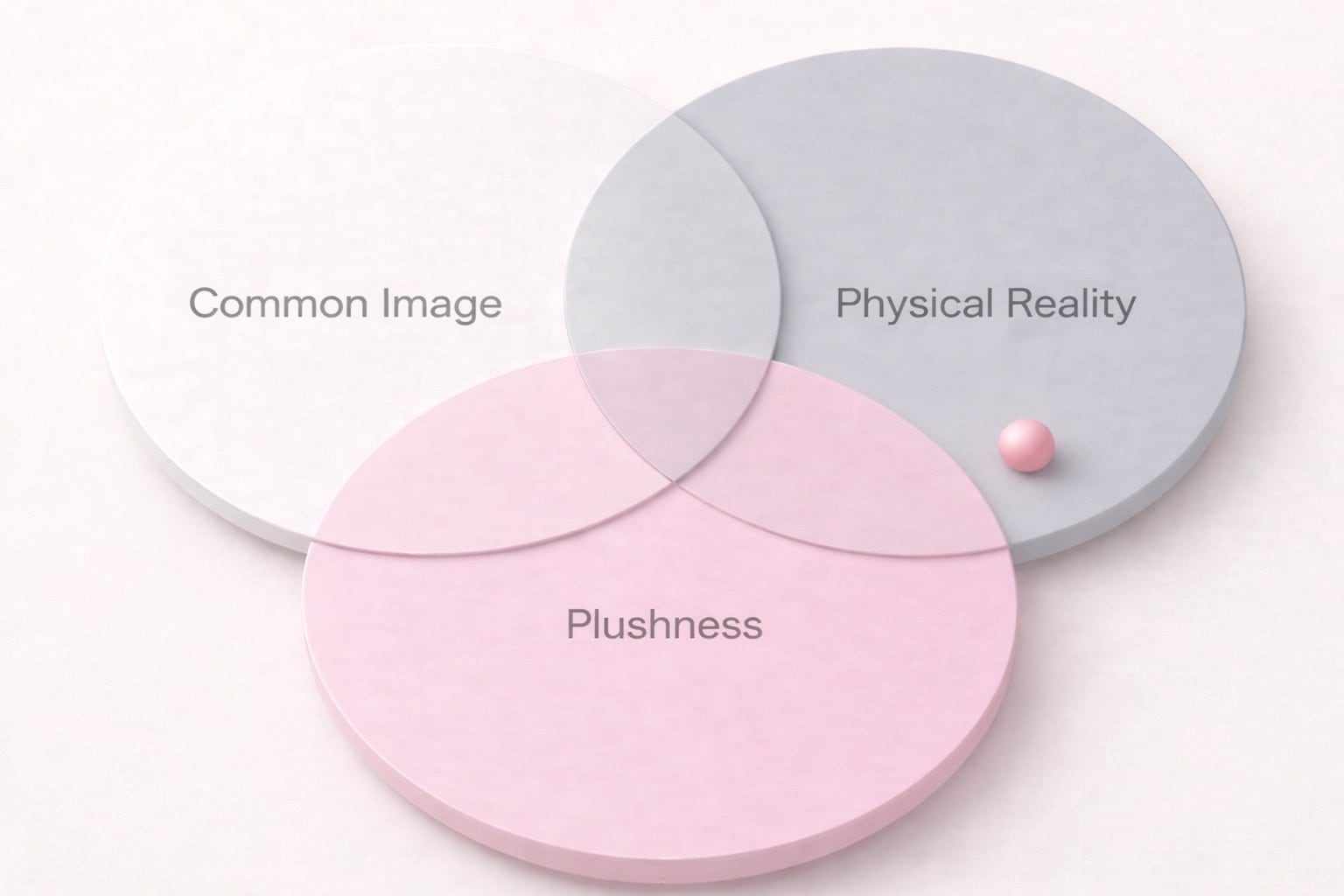
●Common Image
An elephant has a long trunk; a polar bear is white.
There is a sense of “animal-ness” that people share.
These are collective images formed through memory and experience,
including symbolic elements.
For a cat, this might be pointed ears, a rounded muzzle, a flexible body—
but also the feeling of what a cat is to us.
When emphasized too strongly, however, intention becomes overly visible.
Excessive explanation can narrow the viewer’s space for imagination.
Take the carpal pad—the small pad on a cat or dog’s wrist—as an example.
It exists in real animals, yet is rarely considered symbolic of “cat-ness,”
and is often omitted in character depictions.
At capeesh, the carpal pad (the small pink sphere in the diagram)
is positioned as an element outside the circle of Common Image.
● Physical Reality
Careful observation of real animals—their structure, expression, balance, and fur flow—
forms the core of their sense of presence and lifelikeness.
Yet if pursued too scientifically, the endpoint approaches taxidermy.
And if a soft, relaxed object is pushed toward extreme realism,
it risks evoking a lifeless impression.
The carpal pad belongs to this circle of reality.
How visible it becomes is determined carefully
in relation to the overall position of the piece.
● Plushness
Plush objects differ from sculpture.
They allow softness, touch, and quiet presence.
Slight asymmetry or looseness can create comfort rather than flaw.
If cuteness is emphasized too strongly, the piece drifts toward a toy or character.
What we seek is a quieter balance—
not softness meant to be hugged to sleep,
but a presence that can remain nearby over time.
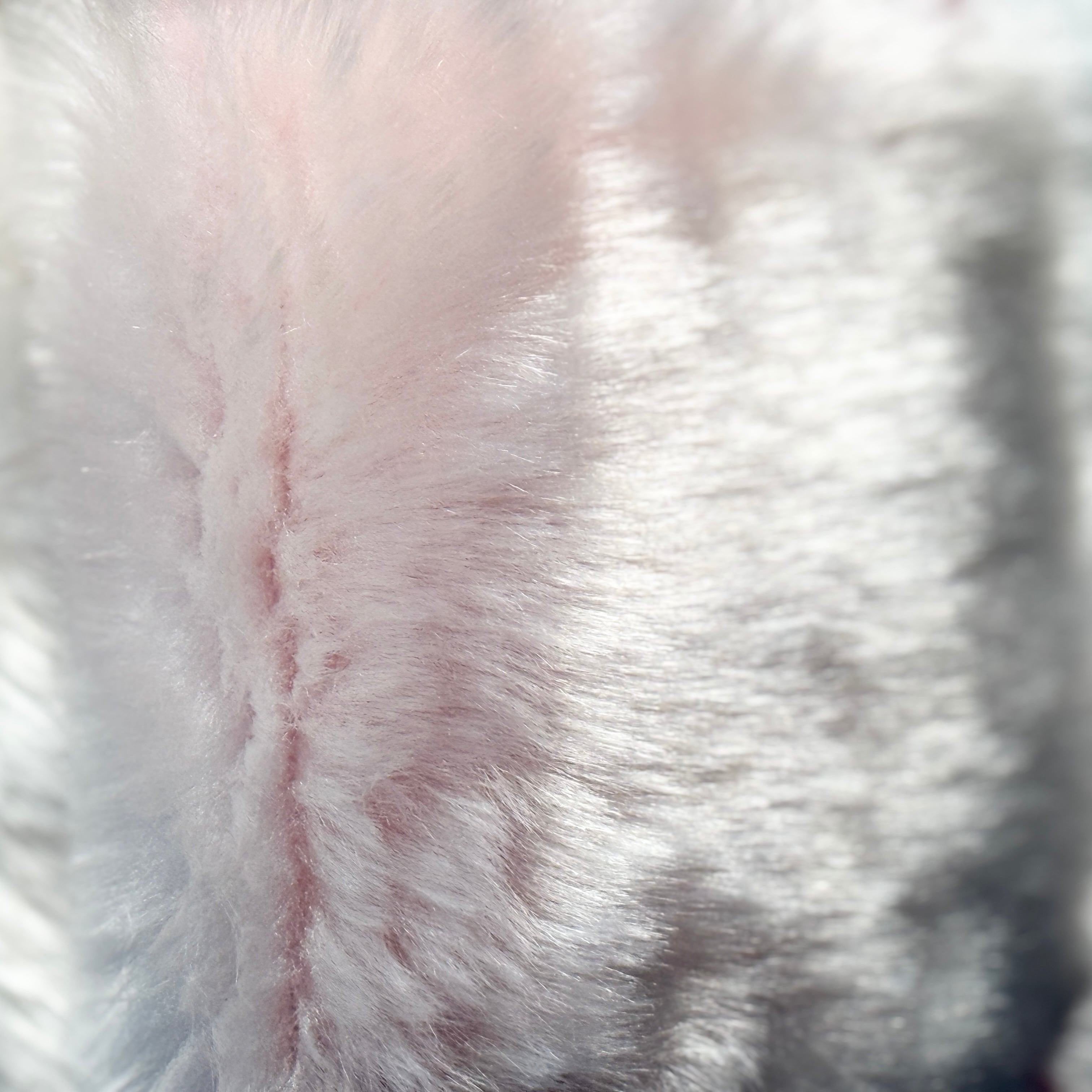
Because the carpal pad is not typically recognized as a symbolic feature of plush animals,
it rarely appears in plush representations.
In that sense, it can be understood as an element that sits slightly outside
the circle of plushness within our framework.
The area where these three circles fully overlap is not broad—
it is a small, delicate point.
Yet when we approach it, the piece begins to feel
less like an object and more like a presence.
By imagining a vertical axis through this point,
we attempt to perceive that intersection three-dimensionally.
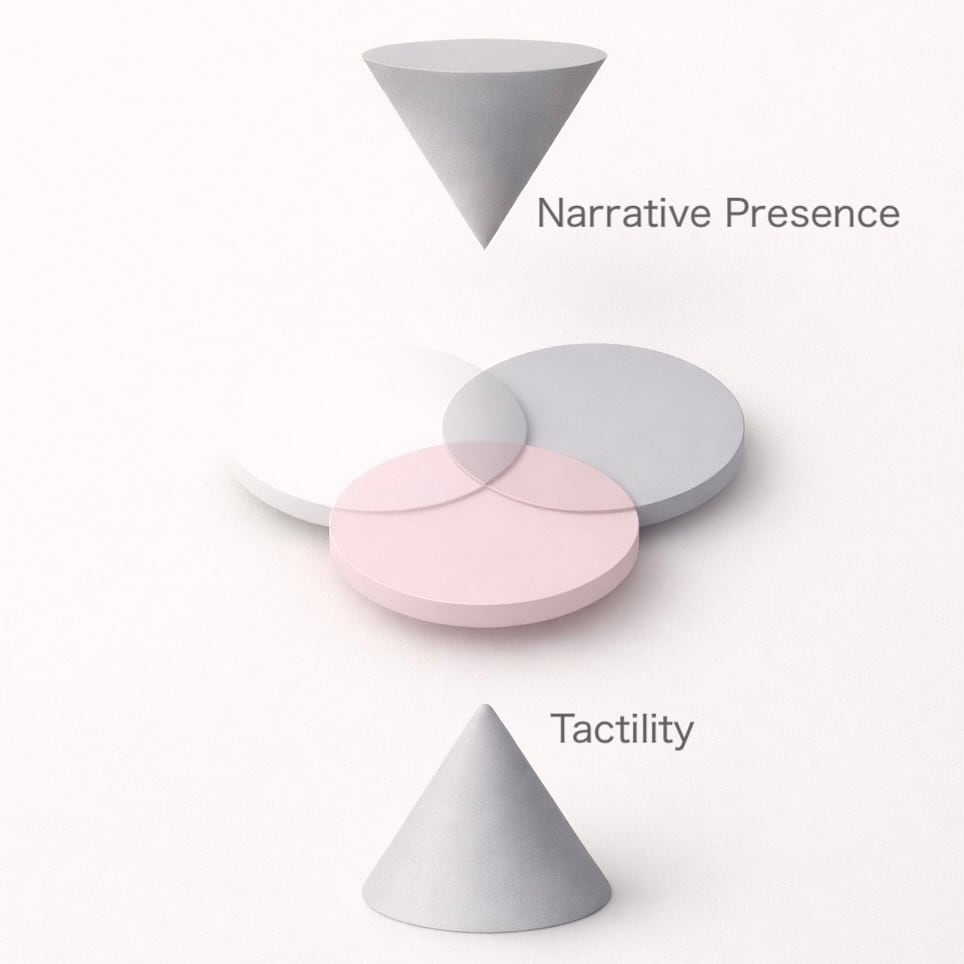
●Narrative Presence
Our pieces are shaped so that a quiet sense of story may dwell
in their expressions and poses—
a gentle calmness, a settled posture,
a face that invites a second glance.
This is neither realism nor common image,
but the space of interpretation:
“How does this being seem to live?”
Narrative Presence extends upward from the center,
lifting the work toward a sculptural individuality.
● Tactility
Another core element is tactility.
The weight of the internal frame,
the movement of glass pellets,
the softness of fur—
These bodily sensations, beyond vision,
support the sense of life within the piece.
The stability when held,
the calmness of its center of gravity,
the quiet presence when resting on the lap—
these are not simply realism
but a sculptural experience revealed only through touch.
Tactility extends downward from the center,
giving the piece a weight that evokes warmth.
Where these three circles and two axes intersect,
there is a sense that a presence seems to take shape—
neither merely cute nor merely real,
but something that suggests a quiet life.
The trace of a living being,
the afterimage of a gesture,
the faint warmth when held—
we continue to search for a balance
in which these elements coexist without excess.
That is where our design philosophy seems to stand at present.
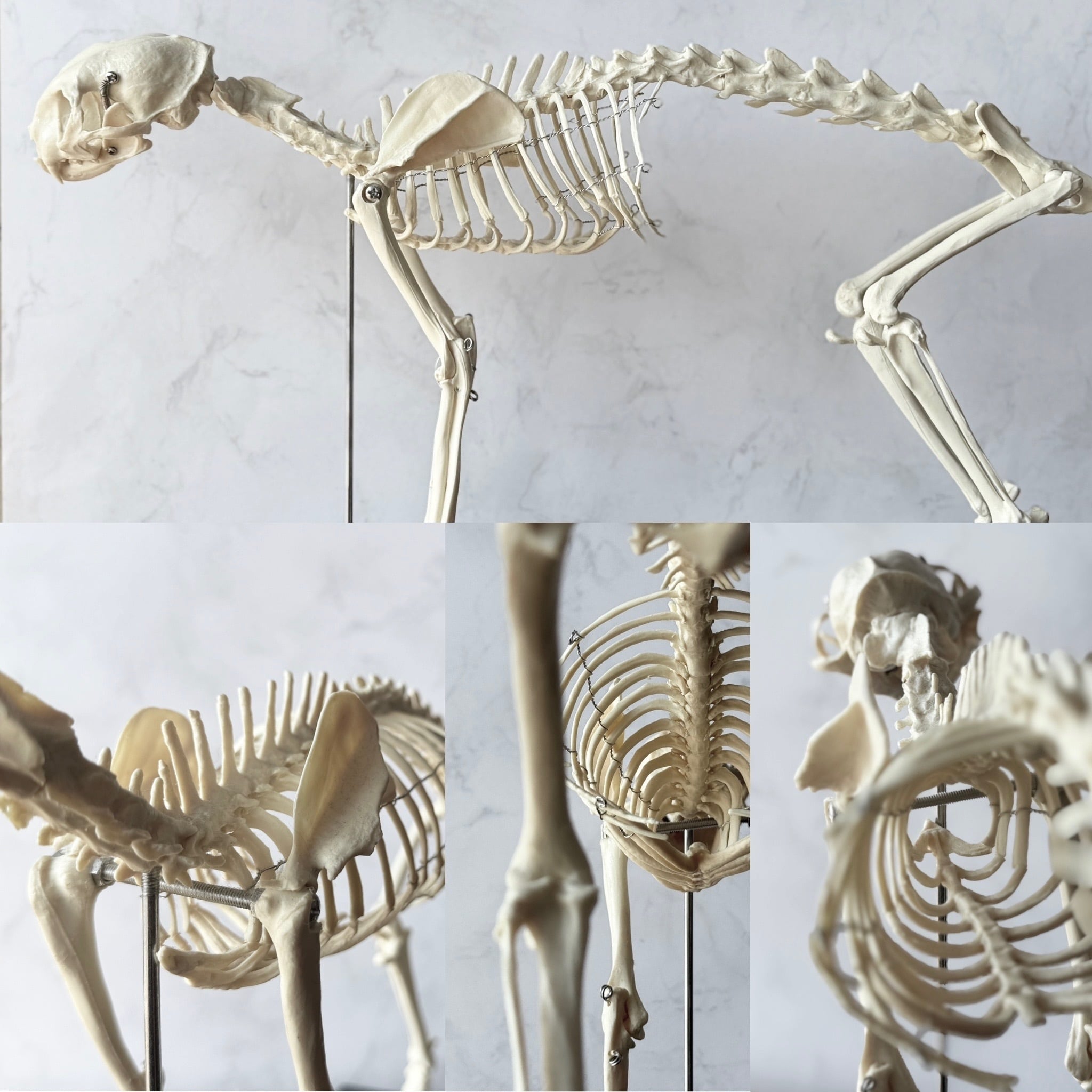
◼️The Layer of Making — The Tip of an Iceberg
Much of our process remains invisible in the finished piece.
Metal armatures are assembled part by part,
each wire wrapped in fabric and sewn into place.
They cannot be seen, nor are they evaluated directly,
yet they support weight, balance, and stability.
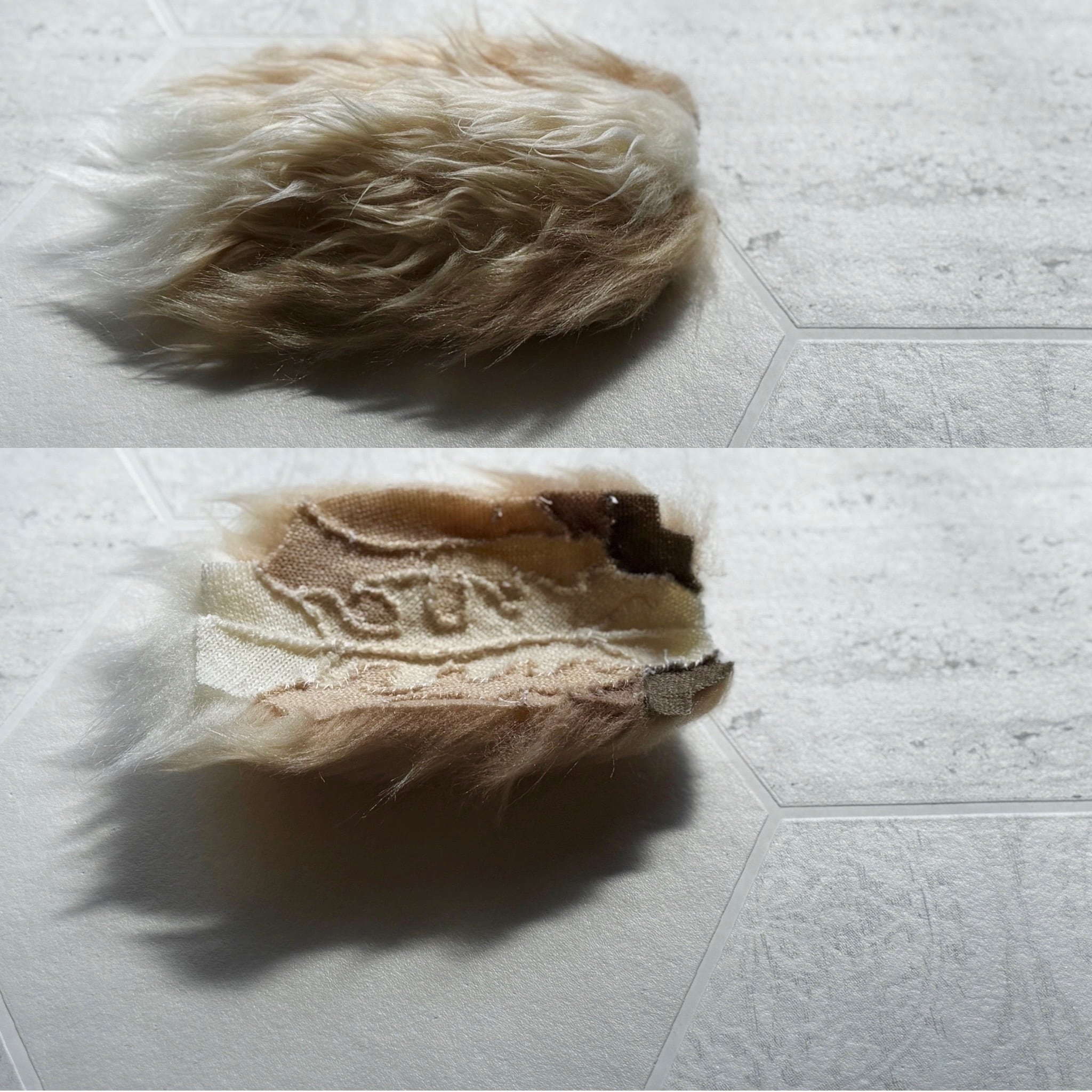
The same is true for fur.
There are more efficient methods,
such as forming with white fur and spray-dyeing afterward.
But we choose to dye each color separately
and sew the pieces together.
Beige, light beige, deep beige—
differences so subtle they may go unnoticed.
The effect is small compared to the labor involved,
yet we continue this method.
Not to create spectacle,
nor to display technique,
but so that form and color come into being simultaneously.
Sewing is a series of decisions difficult to revise—
a form of responsibility.
Rather than creating differences visible at first glance,
we try to refine a state that does not disturb even after long viewing.
As a result, the work grows quieter.
Like an iceberg, most of it lies unseen.
We sometimes ask ourselves:
If it cannot be seen, is it unnecessary?
If it is not understood, is it meaningless?
Judging solely by visible difference,
our approach may not be efficient.
But if all judgment rests on external evaluation,
where do we place our own sensibilities?
Invisible processes are not displays of skill,
but responses to the question
of where we wish to stand.
In that sense, they are as much about how we live
as how we make.
Over time, the process feels less like adding meaning
and more like gently removing excess—
until what remains is simply the sense of being there.
Perhaps we are not trying to perfect an object,
but to approach a point just before roles begin to take form.
We cannot yet define that point clearly,
but we feel drawn toward it.
◼️ Toward a Being Without Role
As we continued making,
we found ourselves gradually incorporating
something like the presence of a young child.
A slightly larger head,
rounded contours,
a lower, calmer center of gravity.
Whether intentional or intuitive is unclear,
yet it suggests a hypothesis.
Young children hold both certainty of being alive
and ambiguity not yet defined.
They exist before roles are assumed.
Perhaps we were drawn to that stance—
not to imitate childhood,
but to explore a quiet state before meaning settles.
Before cuteness,
there is a subtler layer:
a fragile closeness,
a sense of hesitation.
Life eventually acquires roles,
but before that,
there is a time of simply being.
This state is not lack or incompletion—
it is whole in itself.
At the center of the three circles and two axes,
what we sense is not childhood itself
but the atmosphere of life before definition.
Plush objects, being neither fully living nor purely inert,
may be able to remain near that point.
Perhaps what we seek
is not “cat” or “child”
but a more fundamental sensation
before such distinctions arise.
We sometimes perceive being-ness
before recognizing form.
Before identifying ears or muzzle,
we sense the whole.
We call that sensation, provisionally,
the Idea.
◼️Destination: The Idea of Animals
So where are we heading?
The destination resists definition,
yet a certain feeling remains.
Sometimes a stone or a drifting plastic bag
suddenly appears cat-like—
an illusion, yet strangely convincing.
Perhaps we recognize not features first,
but a sense of cat-ness,
and only afterward call the shape a cat.
If so,
that “something” we perceive
may connect to what lies behind real animals themselves.
By “Idea,” we do not mean a Platonic ideal exactly—
rather a layer of perception
unique to each being,
not yet fully expressible.
We continue searching for forms
that might allow us to touch that layer.
◼️ Design Philosophy as Our Present Position
With these thoughts,
we revised our concept in 2026:
Embodying the Idea of animals in plush form.
For us, making is not presenting an answer.
It may be closer to continuing to ask
where we are heading.
We form, dismantle, doubt, and form again.
In that repetition,
a faint outline sometimes appears.
For now, we understand that moment
as the center of what we are pursuing through making.