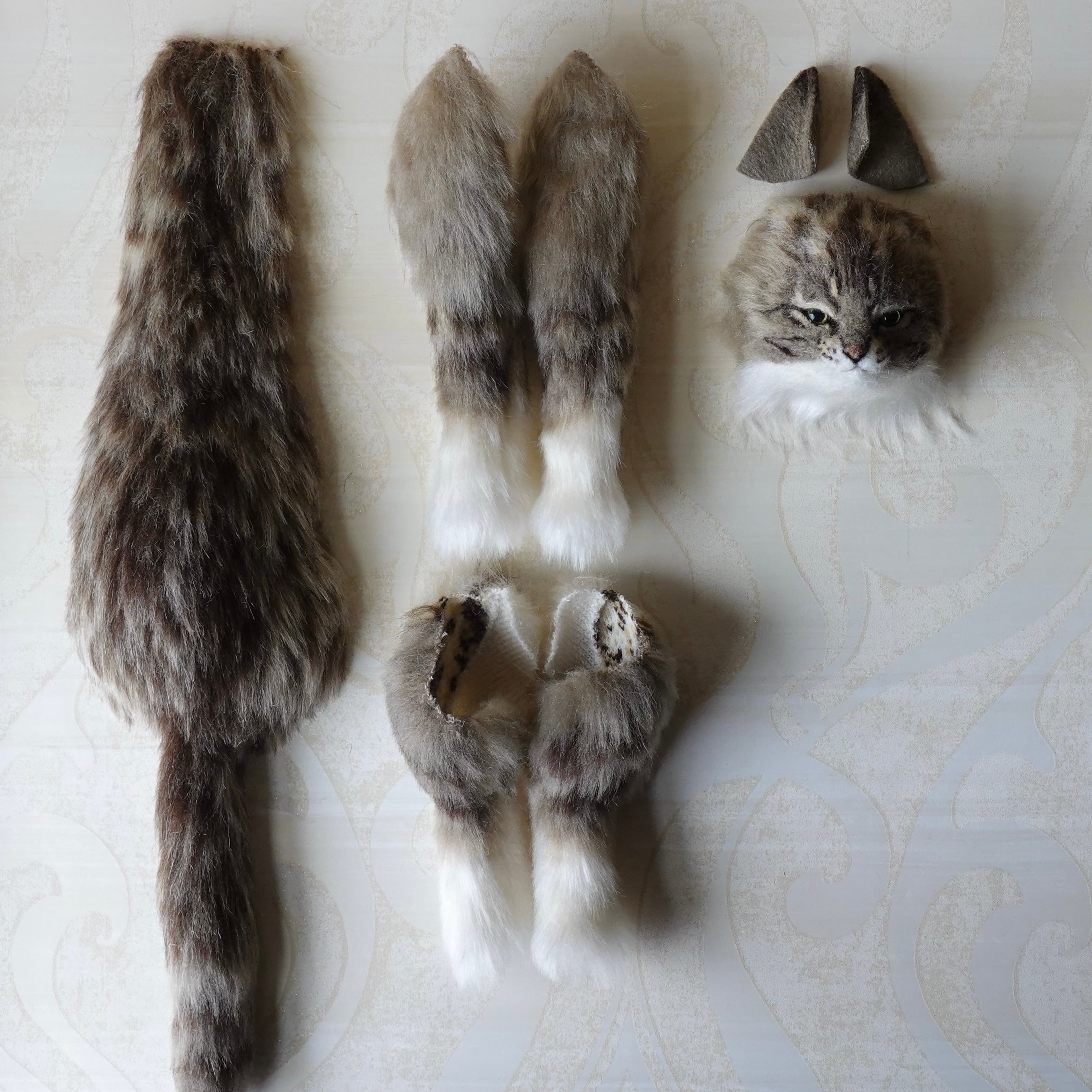
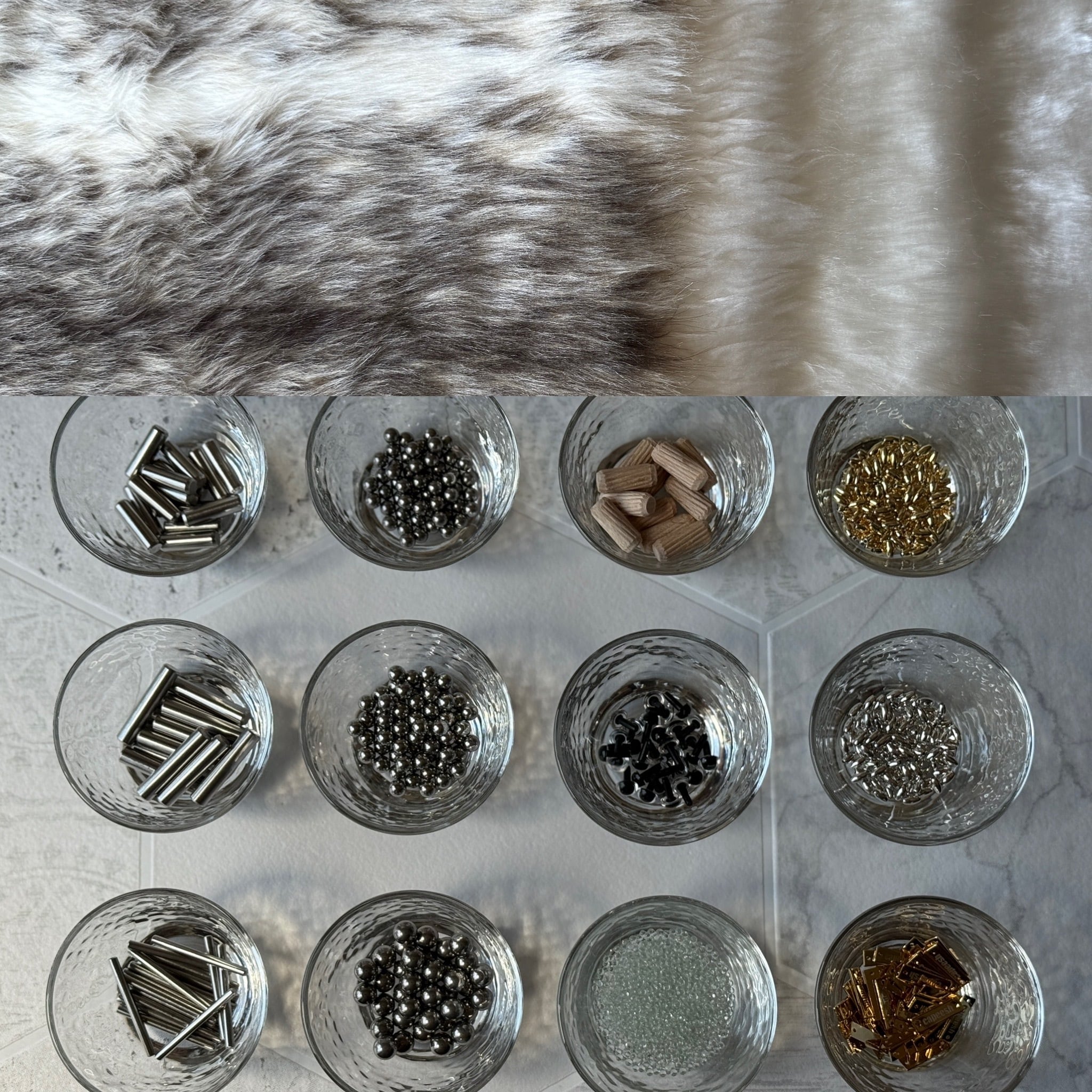
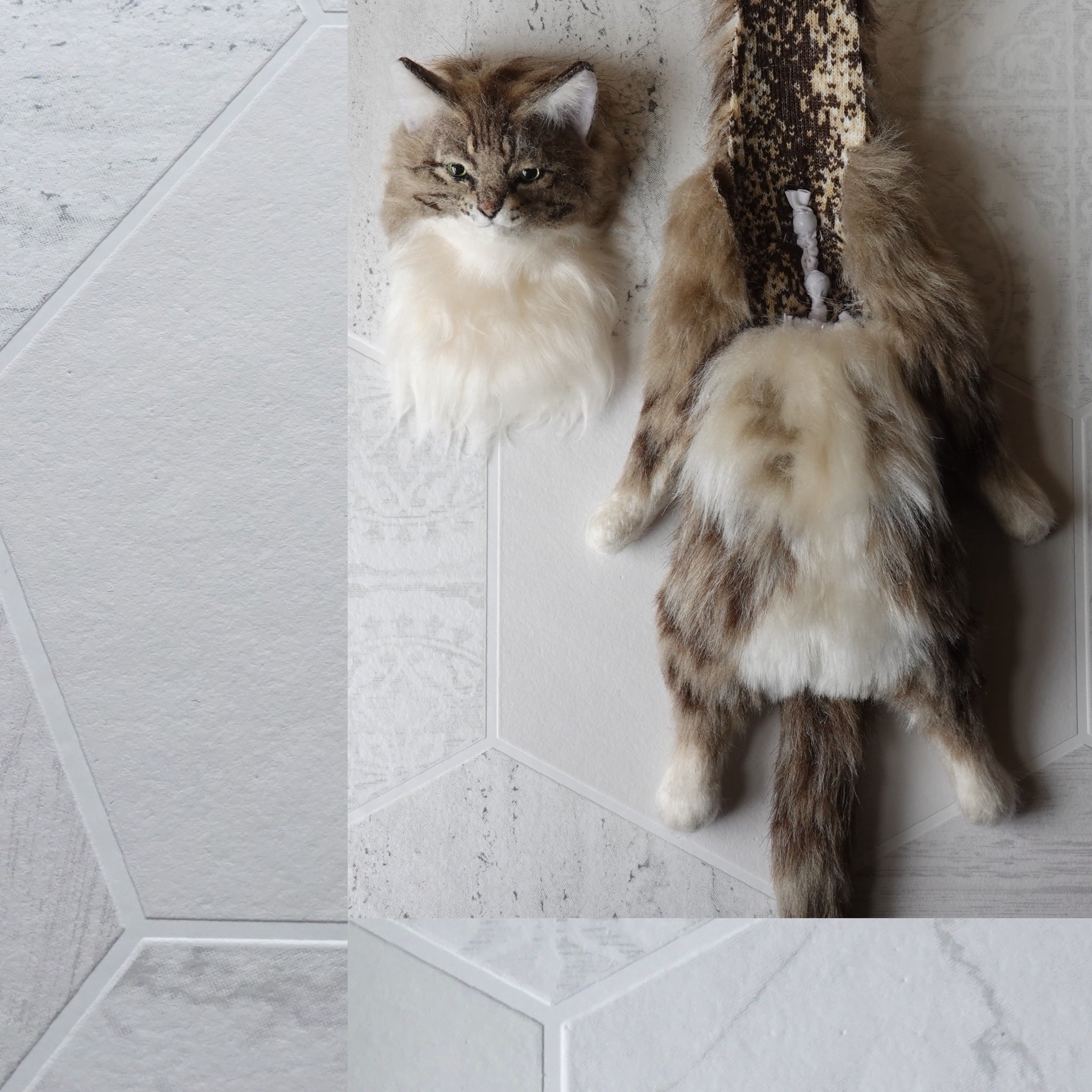
MAKING OF制作工程

ぬいぐるみの中身を知っていますか?
Have you ever wondered what lives inside a plush?

カワ(皮)・ホネ(骨)・ナイゾウ(内臓)・ニク(肉)…。
実際の動物の身体構造に着想を得ながら、カピーシのぬいぐるみは、彫刻のように設計・構築されています。

金属製の「ホネ」に、ガラスペレットの「ナイゾウ」や綿などの「ニク」を取り付け、エコファーの「カワ」で覆う。
「こんなぬいぐるみがほしかった」と思える一体を目指し、試行錯誤を重ねながらたどり着いたこの構造には、柔らかさと造形美の両立を実現するための工夫が詰まっています。

ここでは、カピーシのぬいぐるみがどのようにして生まれるのか——
代表的なネコ作品を例に、その制作工程の詳細をご紹介します。
各パートの合間には、試行錯誤の記録や制作裏話なども「🐈‍⬛ Column(コラム) 🐈‍⬛」としてご紹介します。
Skin, bone, organs, flesh—echoes of a living body.At capeesh, each piece begins as a sculpture.A metal armature becomes the bones.Weighted glass and soft filling form the body’s core.Eco-fur wraps it all as skin.Through countless prototypes, we pursued the plush we always longed for—one that feels tender and alive, yet holds a sculptural
presence.Here, we invite you into our making process.Using our signature cat as an example, we reveal each stage of creation—with little studio notes and moments of trial and wonder along the way,marked by our “ Column ”.

1. 粗デザインの作成 Initial Design Sketch
どんな作品を制作するかを企画した後、複数の資料や画像を元に粗デザインを作成し、どんなフォルムでどんなファーを使用するかをざっくり決めます。初めて制作する動物についてはその生態・習性なども参考にします。

通常販売の作品の場合は特定の一体をモデルにすることはなく、骨格はこのコを参考に、模様はこのコを参考にという形で要素別にモデルを選び、強すぎる個性は抑え、ある程度普遍的なデザインにします。
オーダー(フルオーダー)作品の場合は、ご要望を最大限反映しながらカピーシのコンセプトに則った形でデザインします。
After deciding on the concept, we gather references and create a rough design to define the form and select potential furs. When working with a species for the first time, we also study its anatomy, posture, and behavior to understand its presence. For regular pieces, we do not copy a single animal; instead, we draw inspiration from multiple references—one for skeletal balance, another for markings—combining elements to achieve a universal, timeless expression rather than a single strong personality. For full-order commissions, we reflect the client’s wishes as much as possible while preserving the capeesh philosophy and sculptural sensibility.


2. 材料確保 Sourcing Materials
使用部位別に各材料を紹介いたします。
We carefully gather materials for each part of the body, selecting them with both structure and expression in mind.


⚫︎カワ Skin (Eco-fur)
実際の動物の毛皮に相当する部分を「カワ」と呼びます。
We call the outer surface “skin,” the equivalent of an animal’s coat.

・エコファー(アクリル、ポリエステル) Eco-fur (acrylic, polyester)

色々な毛質(直毛・短毛・カーリーファー等)、毛の長さ(長毛・短毛)、毛の色(一部柄物も含む)のファーを使用し、一つの作品に複数の毛質・長さのファーを使用することが多いです。
どのファーを使うかで作品の全体像が決まるため、適したファーが入手できなければ、あるいは染色しても望む色味にならなければ、作品の制作を断念します。実際、企画したもののファーが確保できずに制作に至ってない作品も多く、ファーの製造会社様あってのカピーシです(カピーシでは動物由来のファーは使用していません)。

ちなみにほとんどのエコファー(フェイクファー)はリアルファー(毛皮)の構造を模して製造されて、長い刺し毛と短い綿毛の二層構造になっています。この綿毛の層は密度が高く、この層がないとボリュームを失い毛が寝てしまいます。
We use eco-fur made from acrylic and polyester, choosing from a wide range of textures and lengths—straight, short pile, curly, long pile, and patterned furs. Most pieces combine several types within a single body to build depth, realism, and a natural sense of life. Because the choice of fur determines the entire presence of the work, we only proceed when the right material can be secured or dyed to the exact tone we envision. Many concepts never leave the sketch stage simply because the perfect fur could not be found. capeesh does not use animal-derived fur; our pieces exist thanks to the skill and innovation of modern eco-fur makers. Quality eco-fur mimics real pelts with a dual structure: long guard hairs and dense underfur. Without this underlayer, the fur would collapse and lose volume, unable to stand with the quiet fullness that gives each piece its gentle breath and silhouette.


⚫︎ホネ Bones
実際の動物の骨格に相当する部分を「ホネ」と呼びます。
We refer to the internal support structure as “bones,” echoing the framework of a living creature.

《頭部のホネ》 Head structure

・ステンレス球 Stainless steel beads

・ガラスペレット glass pellets

・綿 stuffing

・布 fabric


《頭部以外のホネ》 Body structure

・ステンレス円柱 Stainless steel rods,

・ステンレス球 stainless steel beads

・タングステン球 tungsten beads

・木製円柱 wooden rods

・ガラスペレット glass pellets

・綿 stuffing

・布 fabric

身体の内部に入れるホネは文字通り骨格(スケルトン)の役割とオモリの役割を担っています。素材は部位によってステンレス・タングステン・木材を使い分け、その一つひとつをフェルトや伸縮性のある布で包んでいます。

頭骨・背骨・尾椎(尻尾の骨)・胸郭(胸骨+肋骨)・骨盤・四肢の骨・指骨にあたるホネをそれぞれ制作していますが、解剖学上の実際の骨とは形が似ているものとそうでないものがあります。

頭骨と胸郭には、ステンレス製の球やガラスペレットをオモリとして入れ重心を調整することで、上を向いたり下を向いたりしたポージングができるようにしています。同様に胸骨にもポージングのバランスを取るためのオモリとして中にガラスペレットを入れています。

腕と脚のホネは木製ではなくダウエルピンというステンレス製の円柱を使っています。ダウエルピンは主に高精度が要求される金型部品や治具を接合する際に使われる部品で、太さも長さも色々あって、今では骨格のデザインに合わせて選べるようにたくさん常備しています。
The internal “bones” serve both as a true skeletal armature and as weighted elements that give each body its natural balance. Depending on the area, we use stainless steel, tungsten, or wood, wrapping each piece in felt or stretch fabric. We construct bones corresponding to the skull, spine, tail vertebrae, rib cage, pelvis, limbs, and even fingers, though some shapes follow real anatomy closely while others are abstracted for sculptural function. The skull and rib cage contain stainless beads or glass pellets to fine-tune the center of gravity, allowing the head to tilt upward or downward naturally. The sternum also carries weight for posing stability. For the arm and leg bones, we use stainless dowel pins rather than wood. These industrial precision rods—normally used in molds and jigs—come in many diameters and lengths. Over time, we have assembled a wide selection to match each unique skeletal design.


🐈‍⬛ Column 🐈‍⬛: ダウエルピンに至るまで
The Path to Dowel Pins

最初にぬいぐるみの中にホネを入れたのは、綿を詰めた作品の形状が安定せず、膨らんだり歪んだりするのを制御するためでした。

ネコの形状は流動的で、丸くなったり長くなったりして捉えにくい。でも、中にある「絶対に変わらない骨格の部分」を押さえておけばネコの本質を見失わないのではないか、と考えたのです。この辺りは大学で学んだ彫塑の考え方が役に立ちました。
ホネを外側のカワで包んでみたら思いの外「くったり」していて可愛いのです。でも、木製のホネではファーの裏地の反発に負けてしまい手足が理想の「くったり」「だらーん」にはなりません。そこで「もっと重いホネを」と探し求め、その存在を見つけるまで、web検索では簡単には見つけられず、いろんな方面の知人に訊いたりする中でダウエルピンにたどり着きました。
The first time I placed “bones” inside a plush, it was simply to keep the form from swelling or collapsing as stuffing shifted. A cat’s shape is fluid—round one moment, elongated the next—never resting in a single outline. I wondered if holding on to the “unchanging core” beneath that softness might preserve the true essence of a cat. My sculpture studies in university guided that thought. When I wrapped the bone structure in fur for the first time, the result was unexpectedly soft and endearing, a gentle looseness with life in it. But wooden bones could not overcome the resistance of the fabric backing; the limbs never relaxed into the perfect “floppy” drape I imagined. I sought weight—bones that could surrender to gravity. It wasn’t something a simple web search would easily reveal. Asking around through different fields and acquaintances eventually led me to stainless dowel pins. Heavy, precise, and just right for the softness I was chasing.


🐈‍⬛ Column 🐈‍⬛: タングステンに至るまで
The Path to Tungsten

以前は指骨(手足のポーのホネ)にステンレスの球のみを使用していました。成猫ではそれで問題なかったのですが、四肢が短くて細い仔猫を制作する際に問題にぶつかりました。ステンレスではオモリとして軽くファーの生地の硬さに負けてしまい思うように四肢が下に垂れない。
かといって、より重いステンレスを使用するにはその分ポーを大きくしなければならない。仔猫なのでむしろポーは小さくしなければならないのに。もっと「重力に素直な」素材はないのか。
そこで同じ大きさでもステンレスより重い素材を探すことになります。
重くて入手しやすい金属を探す中で、比重(同じ体積の水の質量との比率)がステンレス(7.5~8.0)の2.5倍ほどのタングステン(19.3)にたどり着きました。金もほぼ同じ比重ですが、当然却下。
タングステンは、タイ釣りなどのルアー(擬似餌)の素材として使うものだそうで、釣具店から取り寄せています。
「水の抵抗が小さいままルアーを素早く深くに沈めたい」という釣り人と「小さいぬいぐるみでも手足をくったりさせたい」というぬいぐるみ作家による重力への想い。
今では仔猫だけでなく成猫も含め全ての作品のポーにもステンレスと組み合わせる形でタングステンを使用しています。
In the beginning, I used only stainless steel beads for the tiny bones inside the paws. That worked for adult cats, but when I began sculpting kittens—short limbs, delicate frames—I encountered a challenge. Stainless was too light; the fabric pushed back, and the little legs would not fall naturally. Yet increasing the size for more weight was impossible—kittens must have small paws, not larger ones. I needed a material that obeyed gravity more faithfully, without growing in size. So I searched for a metal heavier than stainless at the same volume. That journey led me to tungsten, with a density roughly 2.5 times greater than stainless steel. Gold shares a similar density—but of course, that option was immediately dismissed. Tungsten, I learned, is used for fishing lures, to sink quickly and cleanly through water. I order it from tackle suppliers. There is a quiet kinship, I think: anglers seeking weight to cut through water, and a plush sculptor seeking weight to let tiny paws surrender to gravity. Today, I use tungsten not only for kittens, but for all cats, pairing it with stainless to create that perfect, gentle “flop.”


⚫︎ナイゾウ Organs
実際の動物の内臓に相当する部分を「ナイゾウ」と呼びます。
We refer to the internal filling that gives volume and life to the body as “organs,” echoing the role of real anatomy.

・ガラスペレット Glass pellets

・布 Fabric

ナイゾウとしてガラスペレットを布袋に入れたものをホネに繋げる形で腹部に入れています。これはお腹の中でオモリの役割を担います。
大きなお腹、予想されるポーズによっては、袋の形状や個数を変えています。内部のペレットが計算通りに動いてくれると、自然な姿勢や形状が保たれます。

そもそもぬいぐるはstuffed animals(詰め込まれた動物)。一般的にもぬいぐるみは、中にパンパンに綿を詰め込んでいるイメージが強いですが、カピーシの作品の内部は、柔軟性を維持するために空洞が多く、綿はむしろ少なく、布で包まれた金属や木材やガラスペレットが入っています。
For the “organs,” we place glass pellets inside small fabric pouches and connect them to the internal bones, setting them within the abdomen as weighted elements. Depending on the desired belly shape and expected poses, we adjust the pouch size, shape, and number. When the pellets move as intended inside the body, the silhouette and posture settle into natural, lifelike balance. Plush dolls are called “stuffed animals”—yet capeesh pieces are not tightly stuffed at all. Instead of being packed full of filling, many areas are intentionally hollow to preserve softness and flexibility. The inside consists mainly of fabric-wrapped metal, wood, and glass pellets, with only minimal stuffing, allowing the body to relax and breathe in a way that feels quietly alive.


⚫︎ニク Flesh
実際の動物の筋肉・脂肪に相当する部分を「ニク」と呼びます。
We refer to the soft material that forms volume between the bones and skin as “flesh,” echoing the role of real muscle and fat.

・エコファー(アクリル、ポリエステル) Eco-fur (acrylic, polyester)
・綿 Stuffing

頭部やポーに綿を付けたり、四肢にファーを巻くことで大きさを調整し、首などの一部に綿を入れることで「くったりし過ぎず、硬くなり過ぎず」の調整をしています。

We use small amounts of stuffing around the head and paws, and wrap fur around the limbs to adjust their proportions. A touch of stuffing is also placed in areas like the neck to balance softness and stability—neither too floppy nor too firm—so the piece holds its shape while remaining quietly relaxed.


⚫︎目 Eyes

・差し目(アクリル) Acrylic inset eyes
作品によって、現在直径4.5mm、6mm、7.5mm、9mm、10.5mmの4種を使い分けています。
カピーシでは内省的な雰囲気・ヒトの赤ちゃんのような佇まいを意識して制作しており、その表現の一つとして、本物の動物よりやや小さい目を使用するようにしています。

We select from four sizes—4.5 mm, 6 mm, 7.5 mm, 9 mm, and 10.5 mm—depending on the piece. At capeesh, we aim for an introspective, almost infant-like presence, so we intentionally use eyes that are slightly smaller than those of real animals. This subtle choice creates a quiet, thoughtful expression rather than a literal likeness.


⚫︎耳 Ears

・エコファー(アクリル、ポリエステル) Eco-fur (acrylic, polyester)

・フェルト Felt
ファーでフェルトを挟む三重構造。耳の内側にはタフト(耳の毛)をつけています。
場合によって、リンクスティップと呼ばれる耳先から飛び出た毛も制作します。

The ears are built in a three-layer structure, with felt sandwiched between eco-fur. Fine tufts are added to the inner ear, and when appropriate, we also create lynx tips—those delicate hairs that extend from the ear tips, lending a quiet wildness to the expression.


⚫︎肉球 Paw Pads

・ニードルフェルト Needle-felted wool

・ビーズ Beads
肉球は、ニードルフェルトか、ビーズ(色はゴールドまたはシルバー)で表現しています。
ニードルフェルトの方がリアルですが、柔らかい肉球を敢えて硬いビーズにして足元にキラリとアクセントを加えた作品も魅力的です。また爪をビーズで表現することもあります。

Paw pads are crafted either with needle-felting or with beads in gold or silver tones. Needle-felt offers a more realistic softness, but using tiny beads instead creates a deliberate contrast—hard little gems where softness is expected—adding a subtle glimmer and elegance to the feet. At times, we also use beads to represent claws.


⚫︎タグ  Tag

・真鍮 Brass
この作品の静かな署名として、尻尾の付け根に真鍮タグを添えています。
A small brass tag is placed at the base of the tail — a quiet signature of the piece.


3. 材料の加工 Preparing Materials
・ファーの染色 Dyeing fur

入手できるファーでは、色の選択肢が著しく少ないため、多くの場合はファーを染色し、その後コーティング処理を行います。
Because commercially available fur comes in very limited colors, we custom-dye most fabrics and apply a finishing coat afterward to achieve the tone and depth we envision.


🐈‍⬛ Column 🐈‍⬛: ファーの染色の難易度 
The Challenge of Dyeing Fur
多くのエコファーは、毛はアクリル製、裏地はポリエステル製です。裏地は比較的色を吸収しやすいのですが、毛は色素の定着に限界があります。染色を繰り返すことで濃くすることもできますが、そうするとファーの毛質が劣化しかねません。
また、染色は再現が難しく、ファーの質、染料に漬ける時間、水温や室温等によって、色味が微妙に異なってきます。また、濡れた状態では発色が異なるため、小さくカットしたファーを染めて乾かすという染色実験を経る場合もあります。
白いファーだけでなく、最初から着色されたファーも染色しますが、引き算(脱色)はできず、小さい足し算(染色)しかできないため、色の幅には限界があります。その限られた選択肢の中から動物の色を決めるため、デザインより前にファーの確保が必要になります。
ようやくファーが揃うとそこに動物の気配を感じられるようになります。
Most eco-fur has acrylic fibers and a polyester backing. The backing accepts dye relatively well, but the acrylic fibers have limits in how much pigment they can hold. Repeated dyeing can deepen the color, but doing so risks damaging the texture of the fur. Achieving consistent results is difficult: the outcome shifts subtly with the quality of the fur, the time in dye, water temperature, room temperature, and other variables. Colors also appear different when the fur is wet, so we often test-dye small cut pieces and dry them before committing to the final tone. We dye not only pure white fur, but also pre-colored fur; however, color cannot be “subtracted,” only gently added, so the range of achievable hues is limited. This is why securing the right fur must come before finalizing a design—our palette begins with what is possible, not merely what is imagined. When all the fur has finally been gathered, a quiet trace of the animal’s presence begins to emerge.


・ホネ袋 Bone sleeves
それぞれのホネを包むためのフェルトと伸縮性のある布を切り出し、一つひとつを包んで縫っていきます。このホネ袋のための型紙も適宜更新しながら改良しています。
このホネ袋は、ホネとホネを繋ぐ関節の役割も果たすため、その間隔の開け方も非常に重要です。
We cut felt and stretch fabric to wrap each bone individually, then hand-stitch every piece. The patterns for these sleeves are continually refined and updated as the skeletal design evolves. Because these sleeves also function as joints that connect the bones, the spacing between them is crucial for achieving natural, lifelike movement.


・ナイゾウ袋 Organ pouches

お腹の中に入れるナイゾウのための布を切り出します。布には、ガラスペレットが内部で流動させられるような柔らかさと、その重みを抱えることのできる厚さが必要です。
ナイゾウは、作品によって、その数や形状が異なります。
We cut fabric to create pouches that hold the internal “organs.” The fabric must be soft enough for the glass pellets to move freely inside, yet thick enough to bear their weight. The number and shape of these pouches vary depending on the piece, allowing each body to carry its own balance and inner weight.


4. 設計図の作成 Creating the Blueprint

・設計図 Design blueprint

フォルムに合わせて構造やホネの繋ぎ方を設計図に起こします。
資料写真やデザイン画、時には粘土でイメージフォルムを確認しながら、どのような形状にデフォルメして制作するかを決めます。カピーシのぬいぐるみは、テディベア座りで飾っていただくことを前提にしているので、その形状を第一に考え、合わせてへそ天やうつ伏せ、バンザイなども最大限可能になるような形状を模索します。型紙の工夫によって可動域を広げたり、ホネの重さや長さ、ナイゾウ袋の個数や位置などを工夫することで、ポーズが自然に美しく出来るよう、ひとつひとつの個体ごとに設計します。
We draft the internal structure and bone connections according to the intended form. Using reference photos, sketches, and sometimes clay studies to confirm the imagined silhouette, we decide how to stylize and simplify shapes while preserving character and life. capeesh pieces are designed to sit in a teddy-bear posture as their natural resting pose, so that form is prioritized first; from there, we explore designs that also allow for relaxed poses such as lying on the back, facedown resting, or stretching with raised limbs. By refining each pattern to expand the range of motion, and adjusting bone weight and length as well as the number and placement of organ pouches, we design each individual piece so its poses appear effortless, natural, and quietly beautiful.


・デザイン画 Design drawing

使用するファーを揃えて、ファーの質・毛足の長さ・色を指定するための最終的なデザイン画を作成します。頭部ができてからそのキャラクターや色の配分によってデザインを調整することも多く、実際に全体のデザインが確定するのは頭部の仮完成後になります。
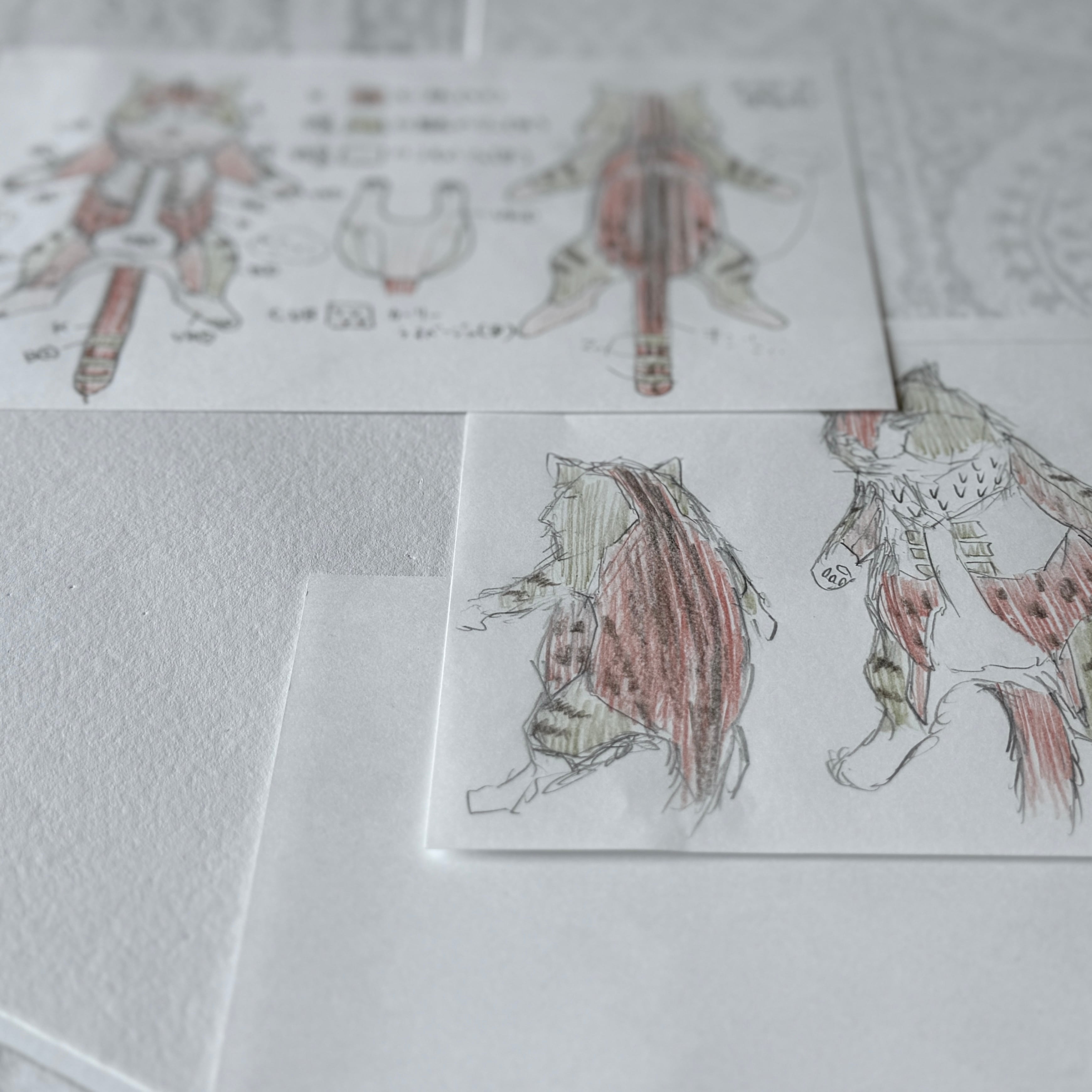
Once the fur materials are gathered, we create the final design drawing to define the fur textures, pile lengths, and color placement. Often, the design evolves after the head is formed; the character and balance of colors become clearer at that stage, so the overall design is typically finalized only after a provisional head is completed.


5. 組立・裁縫 Assembly & Sewing
ここから本格的な制作に入ります。
From here, the true making begins.


⚫︎背骨・尻尾以外のホネ(頭骨・四肢・肋・骨盤・尻尾)を作る
Creating the bones (except spine and tail)
頭のホネは、元になる動物の頭骨を参考にし、これからの作業工程を考えながらニクの部分も考慮して作ります。タテガミなどで下膨れに見える頭は必要に応じてホネの段階で下膨れにしておくこともあります。耳の取り付け位置をホネの段階で決めて土台を確保しておくのが難しいところです。
その他のホネは設計図通りに作成します。くったり感維持のため関節を固定しないので、出来るだけあらぬ方向に関節が曲がらないよう製法の工夫をしています。
The head bones are shaped with reference to real animal skulls, while also considering the layers of “flesh” that will later surround them. For animals with manes or naturally rounded heads, we may give the skull a gentle fullness at this stage so that the final form feels true and balanced. Determining the position and foundation for the ears at the bone stage is one of the most delicate parts of the process.

The other bones are crafted according to the blueprint. To preserve the relaxed, gentle “flop” of the body, the joints are not fixed, so construction methods are carefully devised to allow natural looseness while preventing the limbs from bending unnaturally.


⚫︎ナイゾウを作る
Creating the organs
布で出来た袋の中にガラスペレットを入れて作ります。袋自体の大きさ、ペレットの分量、取り付け個数はそれぞれの個体によって違います。例えば、お腹がふっくらしていて座るときに後ろ側に重心が来るシロクマなどは、お尻とその少し上のお腹、2箇所にナイゾウ袋を取り付けます。上体を後ろに倒した時はお腹のペレットが背中側へ流れ骨盤辺りで重心となり、前傾姿勢の際はお腹側の地面に近い部分で上体を支えています。
We fill fabric pouches with glass pellets to form the “organs.” The size of each pouch, the amount of pellets, and the number of pouches vary for each piece. For example, in a polar bear with a softly rounded belly whose weight naturally shifts backward when sitting, we place two pouches—one at the lower belly and one slightly above it. When the body leans back, the pellets flow toward the spine and pelvis, creating a stable balance; when leaning forward, the pellets settle toward the belly near the ground, supporting the posture from the front. In this way, the internal weights guide each pose, allowing the body to respond quietly to gravity.


⚫︎型紙を作る
Creating the pattern
設計図を元に型紙をおこします。
初めて制作する動物などは仮の型紙を作成し、縫製時の様子を見ながら少しずつ微調整していきます。
デフォルトとなる「基本のネコ」の型紙はありますが、更新を繰り返しており、またカワの模様を型紙に反映するため、全く同じ型紙で制作することはほとんどありません。
表出する模様がファーの毛足の長さ分だけ型紙からズレるため、それを考慮して型紙に反映します。
Using the blueprint as a guide, we draft the sewing pattern. For animals being made for the first time, we begin with a provisional pattern and refine it gradually while observing how the form behaves during sewing. Although we have a foundational “standard cat” pattern, it is continuously updated, and because each fur pattern is reflected into the template, almost no two pieces share exactly the same pattern. The visible markings shift by the length and movement of the fur pile, so the pattern is adjusted accordingly to ensure the intended expression emerges on the finished body.

🐈‍⬛ Column 🐈‍⬛:型紙の変遷
The Evolution of Patterns
開発初期は、なるべく継ぎ接ぎしているとわかる箇所が少なくなるように型紙を取りました。
ちょうど良いファーの毛足の長さが特定され、継ぎ接ぎ部分の心配がなくなり、形状のリアルさを優先して型紙をとることができるようになりましたが、あまり細部まで作りこみ過ぎると、カワ全体が固くなり安定性も失われるため、そのちょうど良い塩梅を考えながら型紙を取ります。模様などの縫い合わせが多くなるなど場合によっては、元の型紙を変更し、模様の切り替えと一緒に立体を表現するよう工夫しています。
In the early stages of development, I drafted patterns to minimize visible seams as much as possible. Once we identified the ideal fur length—one that naturally conceals seams—we were able to prioritize anatomical realism in the pattern. But if the pattern becomes too detailed, the outer “skin” stiffens and the balance is lost, so each pattern is shaped with careful attention to that delicate middle ground. In some cases, when the design calls for more seam lines due to markings, we intentionally alter the original pattern so that the color transitions themselves help sculpt the three-dimensional form.


⚫︎頭部を作る
Forming the head

頭部は、あらかじめ作成したホネにファーを乗せていく要領で制作します。
ホネには頭部の重さを再現し、うつむいたり空を仰いだり出来るように各箇所にオモリを内臓します。

その後、ホネに綿で肉付けをし、目の位置を決め、ファーを乗せていきます。顔にはファーの毛足の長さを活かす部分とニードルフェルティングで細部を作り込む部分があります。
目は制作途中で傷が付く可能性があるため、仮の差し目を入れておき、完成直前に入れ替えます。

The head is created by building on the pre-constructed bones, layering fur over the structure. The bones are weighted to give the head a natural heaviness so it can gently tilt downward or lift toward the sky, just as a real animal would. After establishing the internal form with stuffing, we determine the eye placement and then begin applying the fur. Certain areas of the face rely on the natural length and flow of the fur, while others are refined through needle-felting to shape delicate features. To avoid scratching or clouding the eyes during the process, temporary eyes are used and then replaced with the final ones just before completion.

🐈‍⬛ Column 🐈‍⬛:ニードルフェルティング
Needle Felting
ニードルフェルトの技法が日本に入ってきた頃、嬉々として色々なものを作りました。フェルティングの技法は粘土の彫塑に似ていて楽しかったのですが、次第にその製法が「直接的」だと感じ私には合わないように思うようになりました。
もう少し制約がある方がいい。もう少し不確実性がある方がいい。そこで、ぬいぐるみ制作に移行しました。ところが、ぬいぐるみの解像度が上がるにつれ、ファーを縫い合わせて顔のリアルな曲線や表情を出すためには、物凄くたくさんのパーツのはぎ合わせや超短毛のファーが必要となり、縫い合わせるにはあまりに細か過ぎる。
そうしてフェルティング技法を思い出すに至ります。今では顔と四肢の先はその技法を採用しています。改めてフェルティング技法の面白さと難しさ、その奥深さを実感しているところです。
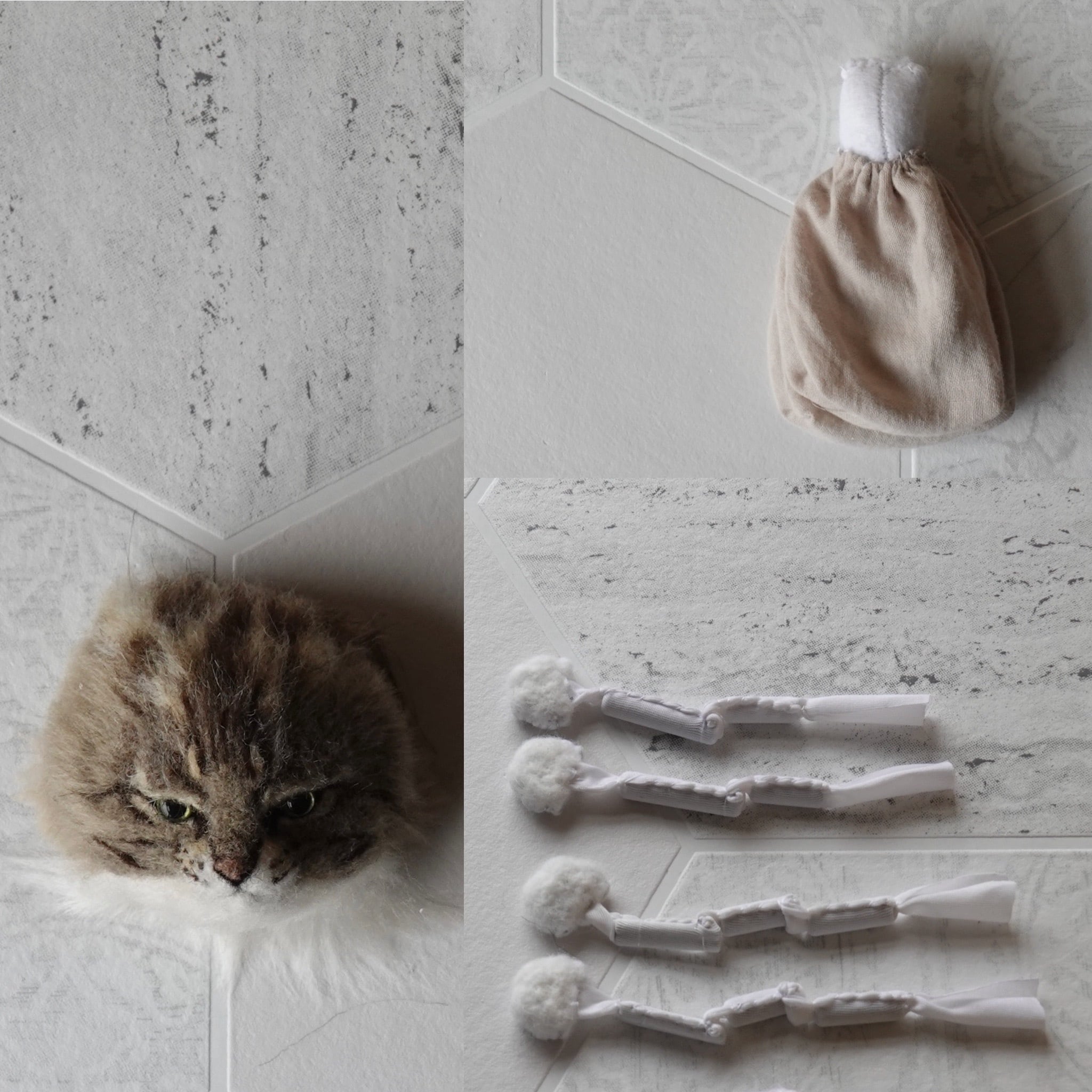
When needle felting first arrived in Japan, I was delighted and made many things with it. The technique felt similar to sculpting clay—intuitive and enjoyable—but over time I began to feel that it was “too direct” for me, too immediate. I realized I wanted more constraints, more uncertainty, so I moved toward plush making instead. As the level of realism in my plush work increased, however, I found that achieving natural facial curves and subtle expressions purely by sewing required countless tiny pattern pieces and ultra-short-pile fur—details far too fine to stitch cleanly. And so I returned to the felting technique. Now, I use it for faces and the tips of the limbs. Once again, I find myself appreciating the depth, challenge, and quiet fascination of felting.

⚫︎背中から尻尾のカワを作る
Shaping the back and tail
型紙に従いファーを切り出し縫い合わせます。
横から見た時のラインが美しい曲線になるように、また、凹凸が不自然にならないように、シルエットを調整しながら縫っていきます。ファーが柔らか過ぎて綺麗な曲線が保てない場合は、裏張りをします。
背中の模様が仕上がると、途端に動物らしさが出てきます。

Following the pattern, we cut and sew the fur pieces. As we stitch, we refine the silhouette so the profile forms a graceful curve and no bumps appear unnaturally. If the fur is too soft to hold a clean line, a backing layer is added for subtle support. Once the markings along the back take shape, the presence of the animal suddenly begins to emerge.


🐈‍⬛ Column 🐈‍⬛:模様の縫い合わせ
Stitching Patterns
最初の頃は、単色かハチワレちゃんなど2色の動物を作るのでせいぜいでした。だんだん欲が出て「次は三毛猫に挑戦。。」などとやっているうちに、縫い合わせる模様が増えていき、今では「同じ色の中にもグラデーションがあって。。」なんて複雑なことに。
パッチワークみたいに模様を縫い合わせていく上で一番難しいのは、元々そんな模様のファーであったかの如く自然に歪みなく仕上げることです。でも、デザイン画の通りに縫い進めて表に返すと、想像以上に美しい模様に出来上がっているのにいつも感激してしまいます。それにつけても、生きている動物たちの持つ、そのびっしりと生えた均質な毛並みや模様の美しさは奇跡のようだと思います。
単色のファーで形を作り後で塗るという技法もありますが、どんなに手間と時間がかかっても布を縫って表現する「裁縫」にこだわっています。
In the beginning, I worked mostly with solid colors or simple two-tone markings like tuxedo cats. As my ambitions grew—“next, let’s try a calico…”—the number of sewn pattern pieces increased, and now even subtle gradients within a single color are part of the work. The greatest challenge in patchwork-like pattern sewing is making the finished form look as though the fur originally grew that way—natural, seamless, without distortion. Yet every time I turn the piece right-side out after stitching according to the design drawing, I am moved by how beautifully the pattern has come together, often more than I imagined. The dense, uniform fur and markings of living animals truly feel miraculous to me. Some creators form the shape first in a single color and then paint the markings, but no matter how much time and effort it takes, I remain committed to expressing markings through sewing—through cloth, needle, and thread.


⚫︎四肢のカワを作る
Shaping the limbs
型紙に従いファーを切り出し縫い合わせます。
ホネを入れて綴じる前に、ダーツの縫い合わせによりカワだけでも美しく立体感がでるよう、表面の毛足を整えておきます。
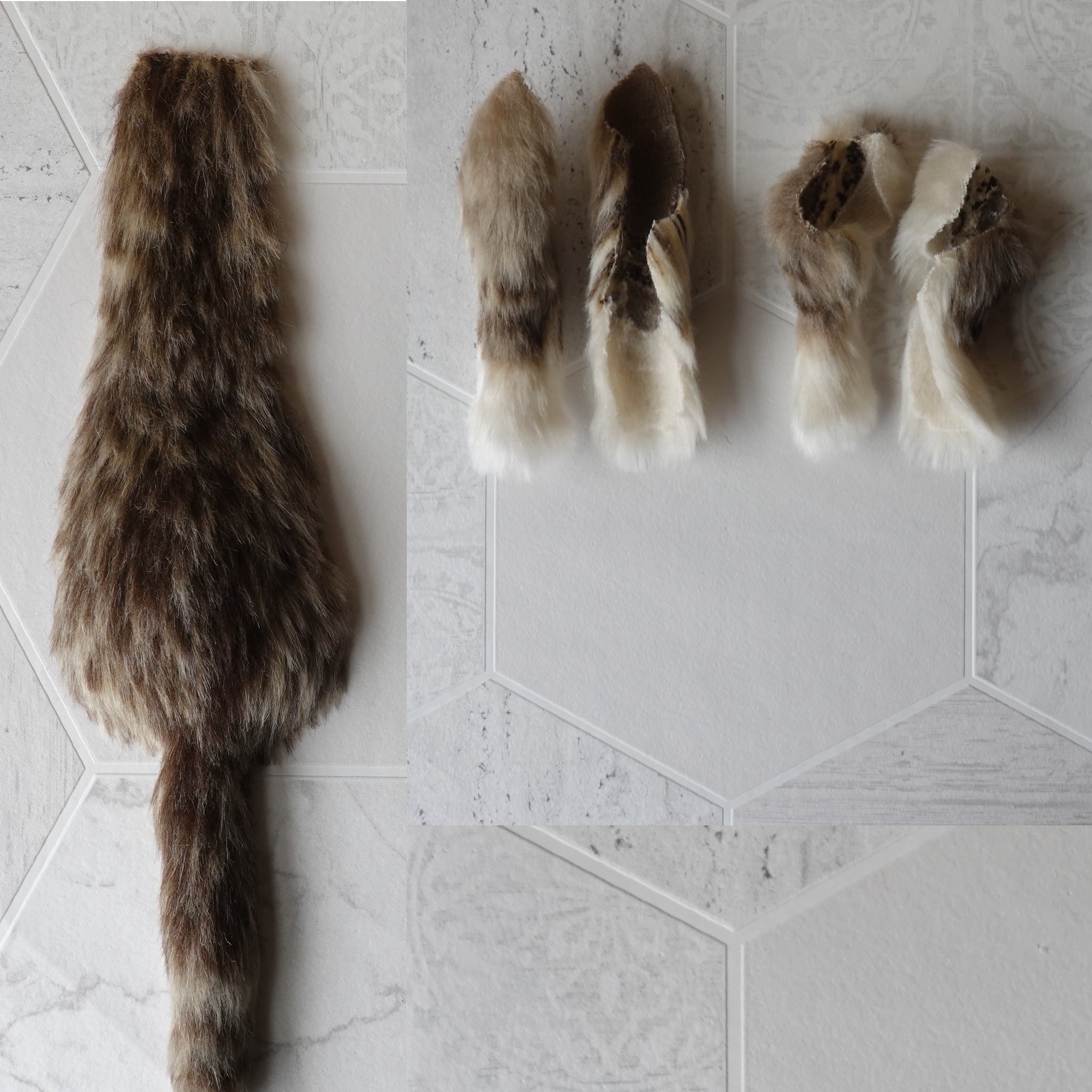
Following the pattern, we cut and sew the fur for the limbs. Before inserting the bones and closing the seams, the darts are stitched and the fur surface is carefully arranged so that the shape holds natural volume and form even before the structure is inside.

⚫︎四肢を完成させる
Finishing the limbs

四肢のファーにホネを入れポーを丸めて固めます。
ポーはホネの形状に沿って指と指の間の隙間を縫い縛り、ニードルフェルティングで形状を整えます。フェルティング技法では、その動物特有のリアルな手足の表情を制作するよう心がけています。
We insert the bones into the fur-covered limbs and shape the paws into a gentle curl. Following the structure of the internal bones, the spaces between each toe are stitched to define the form, and needle felting is used to refine the details. Through this felting work, we aim to capture the subtle, species-specific expression of real animal paws.


⚫︎尻尾を完成させる
Finishing the tail
尻尾はデザインに応じて毛並みを整え、その太さにあったホネを中に入れています。ふわふわな太い尻尾には綿を、シバイヌなどの巻き尻尾にはテクノロート(ポリエチレンのワイヤー)を入れます。
The tail is shaped by arranging the fur according to the design and inserting a bone structure suited to its thickness. Fluffy, full tails are supported with stuffing, while curled tails—such as those reminiscent of Shiba Inu—use technorote (a polyethylene wire) inside to hold their form.


⚫︎四肢を背中のカワに縫い合わせ尻を閉じる
Attaching the limbs to the back panel and closing the rear
カワが全身で繋がっているため、最終的に歪みが出ないよう、出来るだけ下半身から仕上げていきます。この段階で、テディベア座りができるかどうかをしっかり確認します。小さな尻尾をお尻側に巻き込んでいる動物などは、座った時のお尻周りを丁寧にチェックします。
Because the “skin” connects across the entire body, we complete the lower half first to avoid distortion in the final form. At this stage, we carefully confirm that the piece can sit in the teddy-bear posture as intended. For animals with small tails that tuck toward the body, we pay special attention to the rear area while seated, ensuring the silhouette remains clean and natural.


⚫︎背骨に肋骨とナイゾウと骨盤をつけ、背中のカワにつけ「本体」を作る
Building the core body: attaching the ribs, organs, and pelvis to the spine, then securing them to the back panel
カワに背骨を縫い付けます。ぬいぐるみの背中を触ると、ゴツゴツした背骨が指に当たるのがわかります。背骨に他のホネやナイゾウ袋を固定することで、ポーズによって自然に背中や他のパーツが動くようになります。
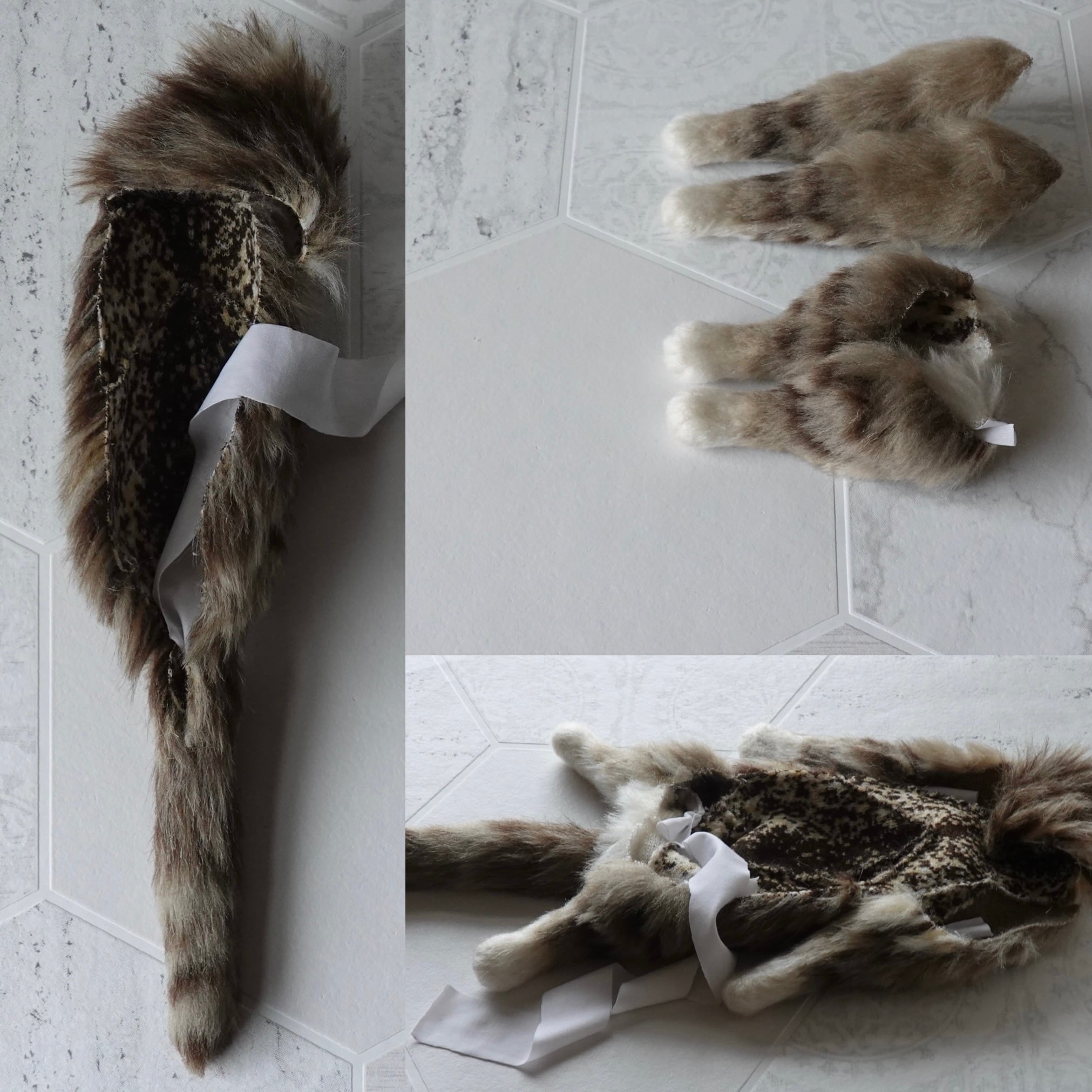
The spine is sewn into the “skin.” When you touch the back of the finished piece, you can feel the subtle bumps of the vertebrae beneath your fingers. By anchoring the other bones and organ pouches to the spine, each part moves naturally with changes in posture, allowing the back and body to respond softly and believably to motion.

⚫︎四肢のホネを背骨に繋げる
Connecting the limb bones to the spine
腕は肋骨に、脚は骨盤に固定します。
これで本体のホネがすべて繋がります。
The arm bones are secured to the rib cage, and the leg bones to the pelvis. At this point, the entire skeletal structure is fully connected.


⚫︎腹のカワを作り本体につける
Constructing and attaching the belly panel
本体側の仕上げをします。
テディベア座りをした場合、お腹は前面になるため、デザインを含めお腹のカワにはこだわっています。
動物はお腹の毛並みの方向が複雑でその複雑さをカーリーファーで表現することが多いです。
また、お腹の模様が複雑な個体も多々あり、場合に応じてチャームポイントとして表現しています。
仔ネコは裏地をピンク色に染めたファーを使用し血色感を出しています。
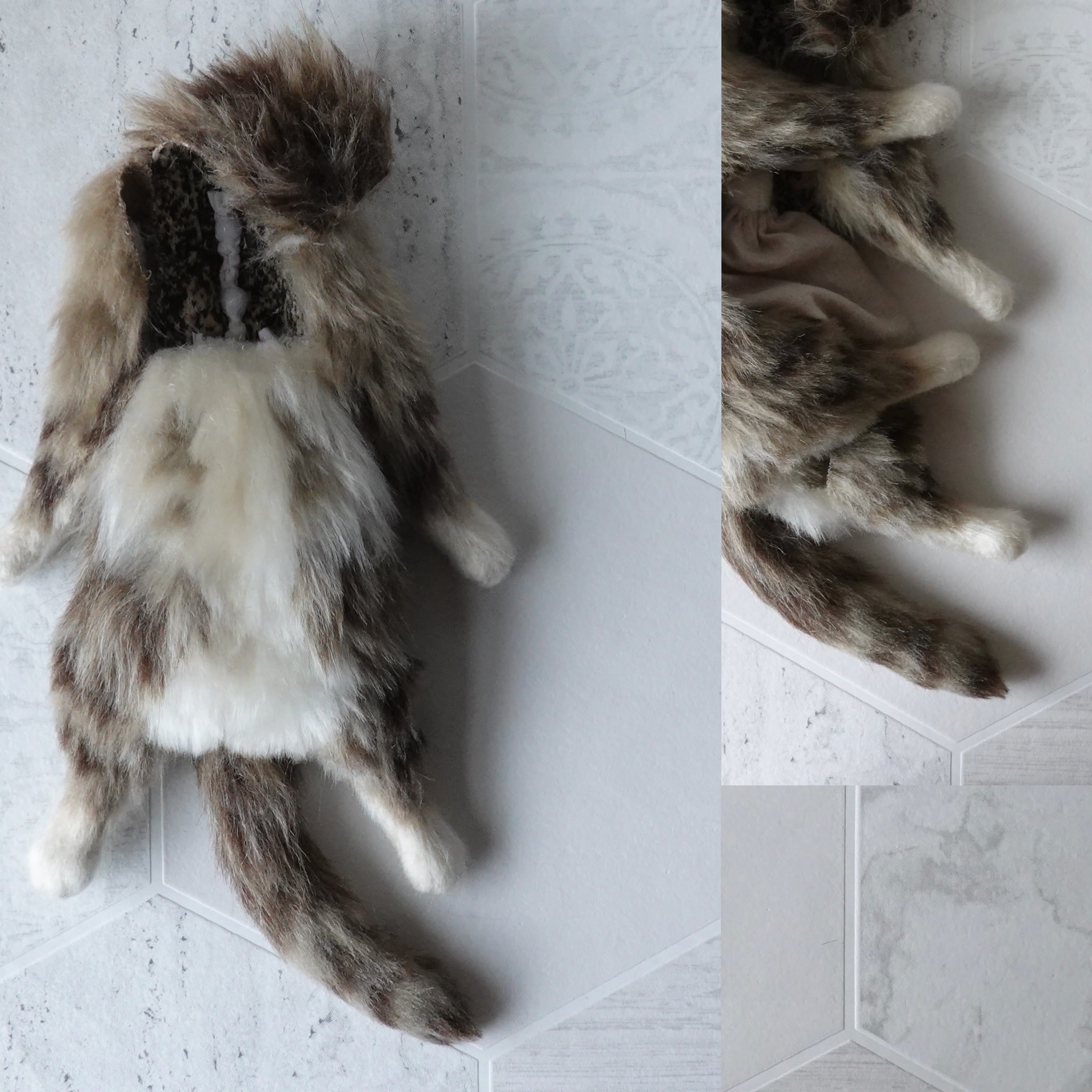
We finish the underside of the body. Since the belly becomes the front surface when the piece sits in its teddy-bear posture, we place particular care on its design. Real animals often have complex directional shifts in the fur on their underside, which we frequently express using curly fur to capture that natural variety. Many animals also have intricate belly markings; when present, we treat them as distinctive features and highlight them thoughtfully. For kittens, we use fur with a softly pink-tinted backing to evoke a gentle sense of warmth and lifelike freshness.

⚫︎目を作り頭部につける
Making and attaching the eyes

差し目をカットし着色し、仮の目と入れ替え接着します。目の大きさ、形、色味、傾き加減で表情や雰囲気だけでなくキャラクターそのものが変わるので最も重要な作業の一つです。
We trim and hand-paint the inset eyes, then replace the temporary ones and fix them in place. The size, shape, color tone, and subtle angle of the eyes transform not only the expression and mood, but the very personality of the piece, making this one of the most critical steps.


⚫︎耳を作り頭部につける
Making and attaching the ears

耳はキャラクターを決める大きな要素です。

動物の耳はその場その場の注意の方向や感情によって向きが異なるため、耳の向きを固定してしまうことには少し抵抗を感じながら付けています。
The ears play a major role in defining character. In real animals, ear direction shifts with attention and emotion, so there is always a slight hesitation in fixing them in a single position. Even so, we seek an angle that feels true to the piece—quietly alert, present, and alive.


⚫︎マフラー(首から胸にかけてのカワ)を作り頭部につける
Creating the “muffler” (the fur from neck to chest) and attaching it to the head
四つ足の動物はこの胸の辺りが発達しており、前足の付け根から大きく前に張り出しています。テディベア座りを採用するに当たり、その形状をどこまでデフォルメするかが課題です。前傾した際に膨らみが崩れないよう裏張りをします。

Quadrupeds have a naturally developed chest that pushes forward from the base of the forelegs. When adapting the form to a teddy-bear sitting posture, the challenge lies in determining how far to simplify and stylize that volume. To preserve the gentle fullness when the body leans forward, a backing layer is added for support.


⚫︎本体に頭部をつける
Attaching the head to the body
本体側の後頭部のファーと頭部側のマフラーを同時に付けていきます。前から見た首の長さと後ろから見た首の長さが不自然にならず、かつ首が固定されないように気を配ります。
The fur at the back of the head and the muffler section are sewn to the body simultaneously. Care is taken so that the neck does not appear unnaturally long or short from either the front or the back, while also ensuring the neck remains free and not rigidly fixed in place.

🐈‍⬛ Column 🐈‍⬛:最大の難所
The Most Critical Moment
カピーシのぬいぐるみは、実際の動物同様に頭頂から尻尾の先まで仕切りがなく「カワはすべて繋がって」いて「ホネもすべて繋がって」いる状態です。互いが引っ張り合い、あるいは譲り合っている。その均衡によりいろんなポージングが可能になっています。現在、背中と頭(と胸部)を別々に制作してから縫合する製法をとっていますが、最終的に左右の耳の下(頭骨に綴じ付けます)に全てが集約されているような気がしています。腕の動き、首の動き、だけでなく、耳下のカワ(ファー)をどのように付けるかによって、体の多くの部分の可動域が変化するように思います。縫合時に余分なファーを切り落とす際はいつも何度も確認してドキドキしながら慎重にカットしています。全工程の中で最も重大な決断をせまられる、最も緊張する瞬間です。
In capeesh pieces, the “skin” runs continuously from the crown of the head to the tip of the tail, just as in real animals, and the “bones” are fully connected as well. Each element gently pulls or yields to the others, and this balance allows for the wide range of natural poses. Although the head, chest, and back are constructed separately and later joined, everything ultimately converges beneath the ears, where the head’s structure meets the body. I often feel that this point determines not only the movement of the arms and neck, but also how the fur beneath the ears is attached—an adjustment that seems to influence much of the body’s mobility. When trimming any excess fur at this stage, I proceed with constant checking and a racing heartbeat. It is the moment of greatest tension, the point in the entire process where the most irreversible decisions must be made.

⚫︎肉球をつける
Attaching the paw pads
ニードルフェルトで表現する場合は、複数の色をブレンドすることも多く、実際の肉球の色や形を意識して作ります。平面的にならないよう、一定の膨らみを持たせるように手足のポーに埋め込んでいきます。
柔らかい肉球を敢えて硬いビーズを縫い付けることで表現する場合もあります。アクセントとして、ゴールドやシルバーが手足の先でキラリと光るのも素敵です。
When creating paw pads with needle felting, we often blend multiple colors and shape them while observing the natural tones and contours of real paws. To avoid a flat appearance, the pads are gently embedded into the paw to give a soft, rounded volume. Sometimes we intentionally express the pads with beads instead—hard little gems standing in for softness. Gold or silver beads catch the light at the tips of the feet, adding a quiet, elegant accent.


⚫︎タグをつける
Attaching the tag
「capeesh」のロゴが刻印された真鍮のタグを背中側の尻尾の付け根に縫い付けます。
シルエットや抱いた時の感触の邪魔にならないよう、注意します。
A small brass tag engraved with the “capeesh” logo is sewn at the base of the tail. It is positioned carefully so it never interferes with the silhouette or the way the piece feels when held.


⚫︎トリミングする
Trimming
デザインによっては長毛のファーと短毛のファーが混在するため、その境界をなだらかにするなど、全体のシルエットを整えます。
ここまでで仮完成です。
In pieces that combine long and short fur, the borders are trimmed and blended so the silhouette remains soft and harmonious. At this point, the piece reaches its provisional completion.


6. 検品・修正・調整 Inspection, refinement, and final adjustments
検品とはいえ、ここで切開を伴うような大幅な修正をすることも多く、一部には基準をクリアできず完成・販売に至らない作品もあります。
Even at this stage, adjustments may require opening seams and reworking internal elements. Some pieces do not meet our standards and do not proceed to completion or sale. Each work must carry integrity in form, movement, and presence before it is considered finished.

🐈‍⬛ Column 🐈‍⬛:最終調整
Final touch
最終調整前には一旦制作から離れ、制作環境や自身を一番良い状態にしてから仕上げをします。
どんな角度から見ても良い形状になるよう、ニードル等で整えます。
また、一度は必ず屋外の日光の下で確認調整します。既に小さな動物のカタチをしているぬいぐるみ、抱えてポー先の細かいファーをカットしている所など「仔猫の爪を切っている人」みたいな気持ちです。最後にドライヤーの温風を当てて、元々のファーの毛の美しさを引き出します。「シャンプーしたての猫を乾かすってこんな感じかな」といつも楽しい時間です。お買い求めいただいた動物たち、時々温風を優しく当てていただくと毛がふわっとしますので是非お試しください。
Before the final adjustments, I step away from the work and prepare both the studio and myself so I can return with clear eyes. Then, using needles and other tools, I refine the form so it looks right from every angle. I always check the piece once outdoors in natural light; holding a small animal-shaped plush in my arms and trimming the fine fur around its paws often feels like clipping a kitten’s tiny nails. At the end, I use warm air from a dryer to bring out the natural beauty of the fur—much like drying a freshly bathed cat. This moment is always a quiet joy. For those who welcome one of these animals home, gently blowing warm air over the fur from time to time will make it bloom softly again.


7. 完成 Completion
作品に合う壁紙を選び撮影します。できるだけ自然光のみで撮るようにしています。
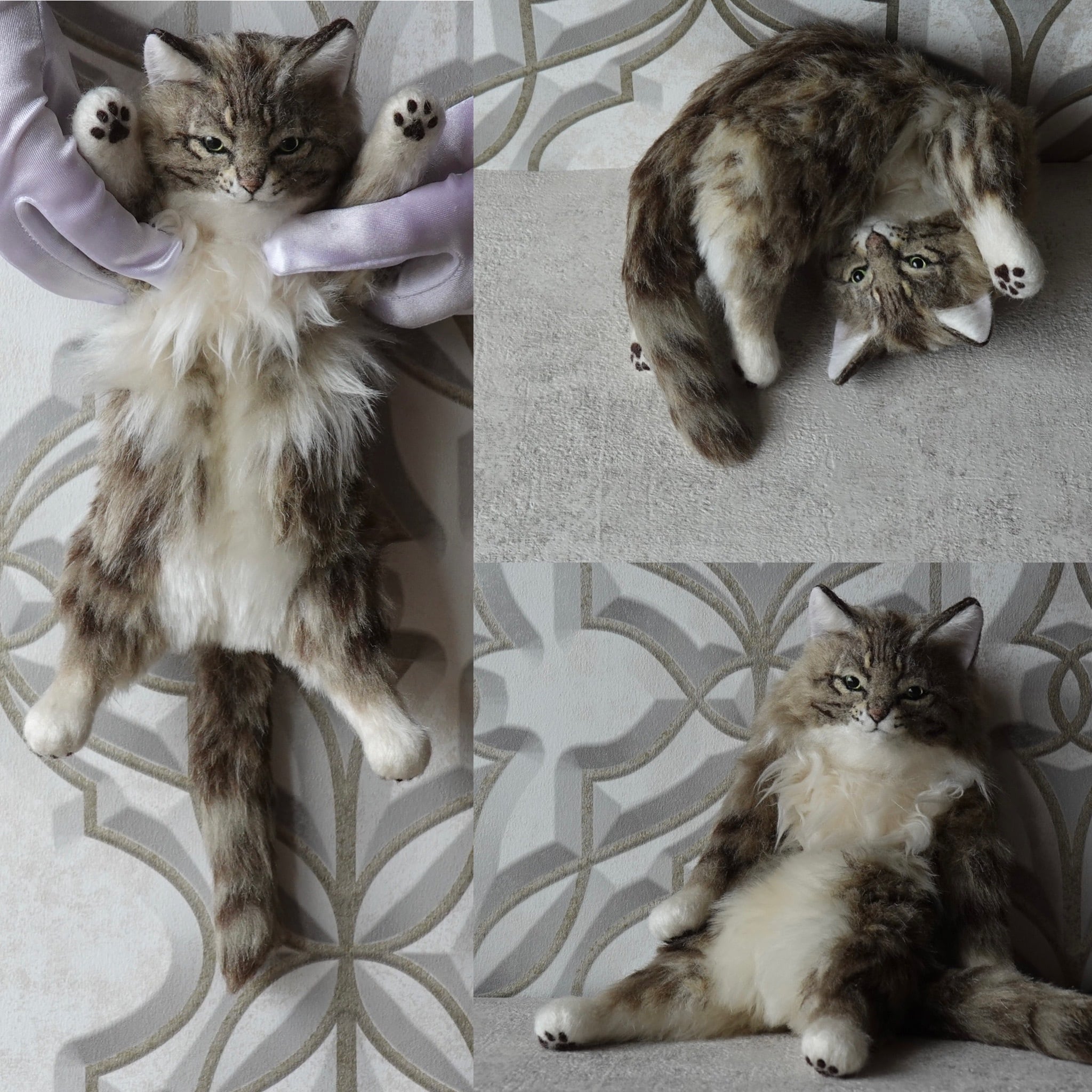
We select a backdrop that complements the piece and photograph it, using natural light whenever possible to honor the quiet presence and texture of the work.

試行錯誤を経て現在この製法に至りましたが、今後も果敢に更新・改良を続けていきます。
「こんなぬいぐるみがほしかった」を目指して。
Through continual trial and refinement, this is the method we have reached today — and we will continue to evolve it with curiosity and courage.
Always in pursuit of the plush we ourselves have longed to meet.


(最終更新 Last updated: Oct 29, 2025)